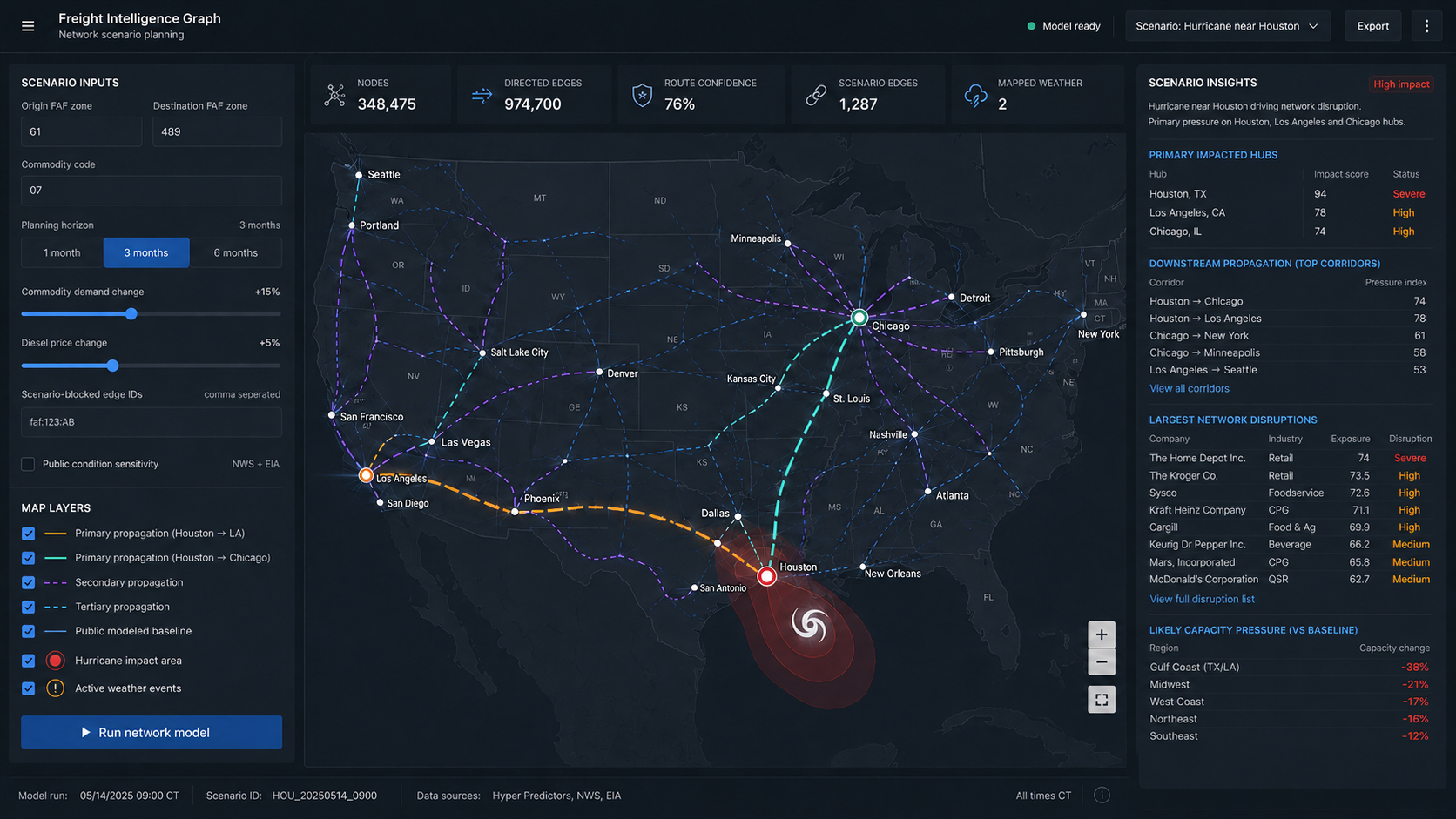
The commercial network that will be released is designed to model the physical economy, infer unseen freight flows and explore how disruptions and structural changes could propagate across markets, facilities, commodities and freight corridors.
Austin, TX August 13, 2026 –(PR.com)– Optimus today previewed the Freight Intelligence Graph, a commercial network twin under development to represent the movement of goods through the physical economy and evaluate how disruptions and structural changes could reshape the networks that support it.
The Freight Intelligence Graph begins with freight, the connective tissue between production and consumption. It is designed to combine a directed model of the U.S. highway system with origin-destination, commodity-demand, weather, fuel-price and proprietary freight data. The objective is to move beyond a static view of where goods travel today and provide a framework for evaluating what could happen when the underlying system changes.
“Most market intelligence explains what has already happened,” said Ed Stockman, founder and CEO of Optimus. “We are building a model of the physical economy to address a more consequential question: What happens next, and what happens after that? A change in one market can alter capacity, economics and commercial activity several corridors away. Understanding those second- and higher-order effects is essential to planning for the future.”
At the core of the Freight Intelligence Graph are Optimus Hyper Predictors, specialized machine-learning models designed to work together to fill gaps between observed freight data. They combine shipment history, economic activity, geography, commodities, seasonality, weather and network behavior to estimate unseen freight flows and forecast where loads, shipper demand and capacity pressure are most likely to emerge next.
“Observed freight data will always leave parts of the network unseen,” said Toby Pasquale, head of engineering at Optimus. “Hyper Predictors close those gaps by combining specialized models, each focused on a different part of the system. Together, they let us infer likely freight flows and identify where demand, loads and capacity pressure may emerge before those patterns become obvious in historical reporting.” Pasquale previously spent 13 years at Amazon building network routing, optimization and predictive transportation systems.
The platform is designed to apply both near-term disruptions and long-range structural developments as explicit scenarios. A hurricane affecting Houston, for example, may initially interrupt local freight activity. The subsequent effects could include rerouted shipments, repositioned capacity, changing fuel and route economics, and additional pressure in markets far beyond the storm. The Freight Intelligence Graph compares a modeled baseline with the scenario to examine how those effects could propagate across routes, commodities, facilities and connected corridors.
The same framework is being designed to represent changes that unfold over years rather than days. Autonomous vehicles could alter operating ranges, terminal locations, labor economics and the relative importance of individual corridors. New infrastructure could redirect industrial activity. Changes in energy costs, trade patterns or commodity demand could shift where goods are produced and consumed.
A more far-reaching scenario is the emergence of humanoid robots capable of manufacturing additional humanoid robots and other goods. If that capability were to scale, production capacity could expand more rapidly and move closer to end markets. Freight flows could shift from long-haul finished goods toward raw materials, components and localized assembly. Facilities, inventories and transportation networks could be reorganized around an entirely different production model.
“E-commerce transformed distribution, fulfillment and consumer expectations,” Stockman said. “Humanoids building humanoids could represent a substantially greater change to the physical economy. The precise outcome is uncertain, but that is the purpose of scenario modeling: to define the assumptions, explore how first-, second- and higher-order effects could unfold, and identify the signals that would indicate whether a particular future is beginning to emerge.”
The prototype currently models roughly 350,000 U.S. highway-network nodes and nearly one million directed road segments. It is being developed alongside Optimus’s proprietary freight data foundation, which maps more than 450,000 geocoded shipper and receiver roles across nearly 400,000 distinct facility locations, all tied to observed freight activity, and represents more than 500,000 distinct directional city-to-city corridor combinations.
Within the prototype, analysts can define changes in commodity demand, diesel prices and modeled route conditions, then compare plausible network outcomes. The system can reroute modeled flows around affected links, identify where relative flow pressure could increase, estimate fuel-cost sensitivity and show how effects may extend into adjacent markets.
The Freight Intelligence Graph is guided by four principles:
Evidence before inference. Verified transactions remain distinct from operational signals, modeled inferences and public estimates.
Scenarios rather than certainty. The platform compares plausible futures without presenting any single outcome as inevitable.
Transparent provenance. Outputs are designed to retain their source, evidence class and limitations.
Defensible abstention. When the available evidence cannot support a conclusion, the system is designed to abstain rather than manufacture certainty.
The prototype is a planning and simulation system, not a live fleet map or ETA product. It does not present a modeled route as an executed shipment, a weather warning as a confirmed road closure, or modeled pressure as actual capacity.
Optimus plans to work with early design partners on disruption planning, network strategy, infrastructure siting and market exposure while continuing to expand the transaction data that grounds the model.
About Optimus
Optimus is a freight-intelligence and revenue-automation company. Its current platform helps freight brokerages identify and win new shipper opportunities and expand existing accounts by combining freight-specific lane and market intelligence with contacts, CRM, sequencing and AI workflows. Optimus is building a broader intelligence layer for the physical economy, with models designed to support transportation providers, manufacturers, retailers, infrastructure operators, insurers and financial markets.
Media inquiries: donna@getoptimus.ai
Contact Information:
Optimus Technology Inc.
Kelsey Galarza
949-697-8606
Contact via Email
www.getoptimus.ai
donna@getoptimus.ai
Read the full story here: https://www.pr.com/press-release/976400
Press Release Distributed by PR.com
Media gallery