Asia-Pacific is on track to generate an estimated USD 29.50 billion by 2035, capturing the fastest regional growth through aggressive EV adoption.
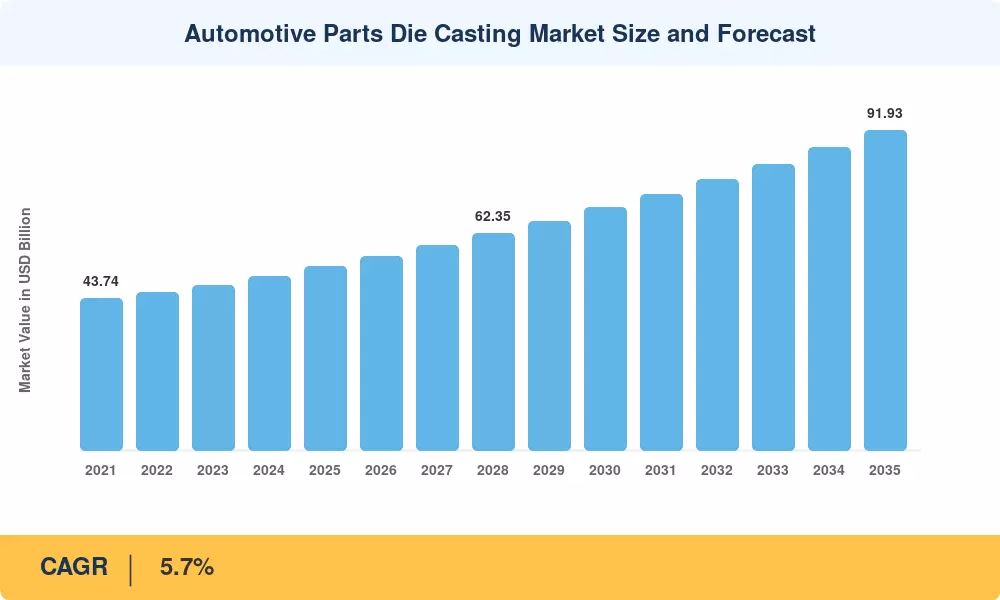
NEW YORK, NY, UNITED STATES, August 26, 2026 /EINPresswire.com/ — According to Market Research Future, the Automotive Parts Die Casting Market is projected to reach USD 91.93 Billion, at a CAGR of 5.7% during 2026 to 2035, driven by integration of lightweight materials and advanced manufacturing techniques in the Automotive Parts Die-Casting Market. This substantial growth trajectory reflects the critical role that die casting plays in modern automotive manufacturing, where the demand for lightweight, high-strength, and cost-effective components continues to escalate. The market’s robust expansion is underpinned by the automotive industry’s relentless pursuit of vehicle weight reduction to meet stringent emission regulations, the growing adoption of electric vehicles requiring specialized lightweight components, and continuous advancements in die casting technologies that enable the production of increasingly complex and precise parts.
Market Overview
Automotive parts die casting is a precision metal casting process that involves forcing molten metal under high pressure into reusable steel molds, known as dies, to produce dimensionally accurate, smooth-surfaced, and high-strength metal components for automotive applications. This manufacturing technique is particularly well-suited for producing complex shapes with excellent dimensional consistency, thin walls, and superior surface finish, making it indispensable for manufacturing a wide range of automotive components including engine blocks, transmission housings, structural components, and various other parts requiring high strength-to-weight ratios. The market encompasses various die casting processes including pressure die casting, vacuum die casting, squeeze die casting, and semi-solid die casting, catering to diverse automotive applications and material requirements.
The key growth drivers propelling this market forward include the automotive industry’s increasing focus on vehicle lightweighting to meet stringent Corporate Average Fuel Economy standards and reduce carbon emissions. The integration of lightweight materials such as aluminum, magnesium, and advanced zinc alloys is accelerating as automakers seek to reduce vehicle weight without compromising structural integrity or safety. The rapid growth of electric vehicles is creating substantial demand for die-cast components, particularly battery housings, electric motor housings, and structural battery enclosures that require the precision and strength offered by die casting. Additionally, the increasing complexity of automotive designs, with tighter tolerances and more intricate geometries, is driving demand for advanced die casting technologies capable of meeting these demanding specifications.
Technological developments are transforming the automotive parts die casting landscape through continuous innovation. The adoption of advanced manufacturing techniques including vacuum-assisted die casting, which removes trapped air from the die cavity to produce porosity-free components with superior mechanical properties, is gaining significant traction. Squeeze die casting, which applies high pressure during solidification to produce components with enhanced density and mechanical properties, is increasingly used for safety-critical structural components. Semi-solid die casting, utilizing partially solidified metal slurry, enables the production of components with excellent mechanical properties and reduced porosity, particularly beneficial for lightweight alloys. Industry 4.0 technologies including real-time process monitoring, automated quality control, and predictive maintenance are being integrated into die casting operations, improving efficiency, reducing waste, and enhancing product quality.
📍 Get Free Sample Report for Detailed Market Insights:
https://www.marketresearchfuture.com/sample_request/5897
Market Segmentation
The automotive parts die casting market is segmented based on production process type, raw material, application type, and regional analysis to provide comprehensive insights into industry dynamics.
By Production Process Type: The market is categorized into Pressure Die Casting, Vacuum Die Casting, Squeeze Die Casting, and Semi-solid Die Casting. Pressure Die Casting dominates the market, representing the most widely adopted process characterized by high production rates, excellent dimensional accuracy, and the ability to produce complex shapes with thin walls. This process is extensively used for producing high-volume components such as engine blocks, transmission housings, and various structural parts. Vacuum Die Casting is gaining significant traction as it effectively removes trapped air from the die cavity, producing porosity-free components with superior mechanical properties, making it particularly suitable for safety-critical and structural applications. Squeeze Die Casting, also known as liquid metal forging, applies high pressure during solidification to produce components with enhanced density, reduced porosity, and superior mechanical properties, increasingly used for structural components requiring high strength and reliability. Semi-solid Die Casting utilizes partially solidified metal slurry with unique flow characteristics, enabling the production of components with excellent mechanical properties, reduced porosity, and improved dimensional stability, particularly beneficial for lightweight alloys like aluminum and magnesium.
By Raw Material: The market is segmented into Aluminum, Zinc, Magnesium, and Other Raw Material Types. Aluminum represents the dominant material segment, accounting for the largest market share due to its excellent lightweight properties, good corrosion resistance, high strength-to-weight ratio, and recyclability. Aluminum die casting is extensively used for engine blocks, cylinder heads, transmission housings, structural components, and increasingly for EV battery housings. Zinc die casting serves a significant market segment, particularly for smaller, more intricate components requiring excellent dimensional accuracy and surface finish, including interior trim parts, door handles, and various electronic housings. Magnesium represents the fastest-growing material segment, offering superior lightweight properties with density approximately one-quarter that of steel, making it increasingly attractive for weight-critical applications including instrument panel beams, steering components, and various structural parts. Other materials including copper alloys and aluminum-silicon alloys serve specialized applications requiring specific material properties.
By Application Type: The market is divided into Body Assemblies, Engine Parts, Transmission Parts, and Other Application Types. Body Assemblies represent the fastest-growing application segment, driven by increasing use of die-cast aluminum and magnesium components in vehicle body structures to reduce weight and improve crash performance, including structural components, door assemblies, and instrument panel beams. Engine Parts constitute a mature but significant segment, including engine blocks, cylinder heads, intake manifolds, and various engine components that benefit from the dimensional accuracy and thermal properties offered by die casting. Transmission Parts represent a substantial segment including transmission housings, gearboxes, clutch components, and various drivetrain components requiring precision and durability. Other Application Types encompass suspension components, brake system parts, steering components, and various interior and exterior components.
By Region: The market covers North America, Europe, South America, Asia Pacific, and the Middle East and Africa. Asia Pacific dominates the global market, driven by massive automotive production volumes, the presence of major automotive manufacturers and die casting facilities, and increasing adoption of lightweight materials. China leads the region as the world’s largest automotive producer and a major manufacturing hub for die-cast components. North America and Europe represent mature markets with strong demand driven by stringent emission regulations and increasing EV production. The Automotive Metal Casting Market encompasses the broader casting industry, while die casting represents a specialized segment focused on high-pressure precision casting processes for automotive applications.
🛒 You can buy this market report at:
https://www.marketresearchfuture.com/checkout?currency=one_user-USD&report_id=5897
Regional Analysis
Asia Pacific dominates the global automotive parts die casting market, commanding a substantial share driven by massive automotive production volumes, the presence of major automotive manufacturers and die casting facilities, and increasing adoption of lightweight materials across the region. China leads the regional market as the world’s largest automotive producer and a major manufacturing hub for die-cast components, with a robust die casting industry supporting both domestic vehicle production and export markets. The Chinese government’s aggressive promotion of electric vehicles is accelerating demand for EV-specific die-cast components including battery housings and structural battery enclosures. Japan and South Korea represent mature markets with advanced die casting technologies and strong demand for precision components, driven by their technologically sophisticated automotive industries. India represents a growing market with increasing vehicle production and a developing die casting industry, supported by government initiatives promoting domestic manufacturing and EV adoption. The region’s expanding automotive manufacturing base and increasing focus on vehicle lightweighting continue to drive die casting demand.
North America represents a significant market for automotive parts die casting, characterized by robust vehicle production, stringent emission regulations, and growing EV manufacturing. The United States leads the regional market with a well-established automotive industry and increasing investment in EV production, creating substantial demand for die-cast components. The region’s focus on vehicle lightweighting to meet Corporate Average Fuel Economy standards is driving adoption of aluminum and magnesium die-cast components across all vehicle segments. The growing presence of EV manufacturers in the United States is creating new opportunities for die casting suppliers, with battery housings and structural components requiring significant die casting capacity. Canada and Mexico, as automotive manufacturing hubs, contribute to regional demand with die casting facilities serving the North American automotive supply chain.
Europe represents a technologically advanced market with strong demand driven by stringent emission regulations, increasing EV production, and the region’s focus on automotive innovation. Germany leads the European market with its prestigious automotive brands investing heavily in lightweight components and advanced manufacturing technologies. The European Union’s aggressive CO2 emission targets are driving rapid adoption of lightweight materials and advanced die casting processes, particularly for structural components. The region’s leading position in electric vehicle production creates substantial demand for specialized die-cast components, with European manufacturers developing innovative battery housing designs using advanced casting techniques. France, the UK, and Italy represent significant markets with established automotive industries and increasing adoption of die-cast components. The Automotive Metal Die Casting Market is closely related to the parts die casting segment, with both addressing similar applications while focusing on different aspects of the metal casting value chain.
South America and the Middle East and Africa represent developing markets with growth potential for automotive parts die casting. South America, led by Brazil, benefits from improving economic conditions and increasing vehicle production, supporting die casting demand through OEM sales. Brazil’s automotive manufacturing base, producing vehicles for domestic and regional markets, sustains die casting demand. The Middle East and Africa, led by South Africa and the UAE, are experiencing steady growth driven by increasing vehicle ownership and improving manufacturing capabilities in certain countries, with the region’s growing vehicle parc creating aftermarket opportunities for die-cast components.
Competitive Landscape and Key Players
The automotive parts die casting market is characterized by intense competition among established metal casting companies, with key players focusing on technological innovation, strategic partnerships, and geographic expansion to strengthen their market positions. The market is moderately consolidated, with a mix of global die casting suppliers and regional manufacturers competing for market share.
Major companies operating in this space include Georg Fischer Ltd, Ryobi Die Casting Inc, Nemak S.A.B. de C.V, Alcoa Corporation, Bühler AG, Dynacast International, Rockman Industries Ltd, Endurance Technologies Ltd, Martinrea Honsel Germany GmbH, Consolidated Metco, Inc (ConMet), Pace Industries LLC, and Gibbs Die Casting Corp. These industry leaders invest significantly in research and development to create innovative die casting solutions that meet evolving automotive requirements for lightweighting, precision, and cost-effectiveness.
Strategic developments are reshaping the competitive landscape as companies adapt to industry transformation. Leading manufacturers are expanding their capabilities in aluminum and magnesium die casting to address the growing demand for lightweight components. Strategic collaborations between die casting suppliers and automakers are becoming increasingly important for developing integrated solutions and ensuring early involvement in vehicle development programs. Acquisitions and partnerships are consolidating expertise in advanced casting processes including vacuum die casting, squeeze die casting, and semi-solid die casting. Geographic expansion into emerging markets, particularly Asia Pacific, is a key strategy for manufacturers seeking to capture growth opportunities in high-production regions.
Latest Industry News and Developments
Recent industry developments highlight the dynamic evolution of the automotive parts die casting market and the strategic responses of key players to emerging trends. A prominent die casting manufacturer recently announced significant expansion of its aluminum die casting capacity to meet growing demand from electric vehicle manufacturers, with new facilities dedicated to producing battery housings and structural components for EV platforms.
Another significant development involves a leading automotive supplier unveiling a new generation of vacuum die casting technology capable of producing large structural components with exceptional mechanical properties and reduced porosity, enabling production of integrated vehicle body structures that significantly reduce weight and improve crash performance.
In the materials innovation space, a notable manufacturer recently introduced a new magnesium alloy specifically formulated for die casting applications, offering improved strength and corrosion resistance while maintaining the lightweight properties that make magnesium attractive for weight-critical applications in electric vehicles.
Market Challenges and Opportunities
The automotive parts die casting market faces several significant challenges that require strategic responses for sustainable growth. High initial capital investment for die casting equipment and tooling presents a barrier for new entrants and capacity expansion, requiring substantial financial resources. The increasing complexity of automotive components demands continuous technological advancement and investment, challenging manufacturers to maintain competitiveness. Raw material price volatility, particularly for aluminum and magnesium, affects production costs and profit margins throughout the supply chain. Supply chain disruptions and logistics challenges create operational difficulties for manufacturers and their customers. The transition toward electric vehicles, while creating opportunities, also requires significant investment in new capabilities and technologies.
Emerging opportunities in the market are substantial and diverse. The rapid growth of electric vehicles represents the most significant opportunity, with each EV requiring numerous die-cast components including battery housings, motor housings, and structural battery enclosures. The increasing adoption of aluminum and magnesium in vehicle structures to meet lightweighting targets creates sustained demand for die-cast components across all vehicle segments. The trend toward vehicle electrification and autonomy is driving demand for complex, high-precision components that die casting can efficiently produce.
Technology-driven possibilities are expanding rapidly across the industry. Advanced manufacturing techniques including vacuum die casting, squeeze die casting, and semi-solid die casting enable production of components with superior mechanical properties and reduced defects. The integration of artificial intelligence and machine learning into die casting operations enables predictive quality control, process optimization, and reduced waste. Advanced alloy development enables production of components with improved properties and reduced weight, expanding the range of applications suitable for die casting. Sustainable manufacturing practices, including use of recycled materials and energy-efficient operations, offer opportunities for differentiation and cost reduction.
To explore more market insights, visit us at: https://www.marketresearchfuture.com/reports/automotive-parts-die-casting-market-5897
Final Market Summary
Key factors expected to influence future development include the pace of electric vehicle adoption, technological advances in die casting processes and materials, regulatory frameworks promoting vehicle lightweighting and emission reduction, and the evolving competitive landscape shaped by strategic partnerships, capacity expansion, and geographic diversification. The automotive parts die casting market continues to play an indispensable role in the global automotive industry, enabling the production of components that are essential for vehicle performance, safety, and efficiency, and will remain a cornerstone of automotive manufacturing for the foreseeable future.
More Related Reports from MRFR Library:
Brake Pad Market : https://www.marketresearchfuture.com/reports/brake-pad-market-23226
Ship Repair and Maintenance Services Market : https://www.marketresearchfuture.com/reports/ship-repair-maintenance-service-market-23258
Specialty Commercial Vehicle Market : https://www.marketresearchfuture.com/reports/specialty-commercial-vehicle-market-23275
Tow Truck Market : https://www.marketresearchfuture.com/reports/tow-truck-market-23320
Railway Axle Market : https://www.marketresearchfuture.com/reports/railway-axle-market-23325
Recreational Boat Parts and Accessories Market : https://www.marketresearchfuture.com/reports/recreational-boat-parts-accessories-market-23326
Used Golf Cart Market : https://www.marketresearchfuture.com/reports/used-golf-cart-market-23331
Automotive Safety Restraint System Market : https://www.marketresearchfuture.com/reports/automotive-safety-restraint-system-market-23417
Small SUV Market : https://www.marketresearchfuture.com/reports/small-suv-market-23424
Charter Bus Service Market : https://www.marketresearchfuture.com/reports/charter-bus-service-market-23429
Market Research Future
Market Research Future
+1 855-661-4441
email us here
Legal Disclaimer:
EIN Presswire provides this news content “as is” without warranty of any kind. We do not accept any responsibility or liability
for the accuracy, content, images, videos, licenses, completeness, legality, or reliability of the information contained in this
article. If you have any complaints or copyright issues related to this article, kindly contact the author above.

Media gallery