Bidirectional Charging Safety Accessories Market Forecast: Surpassing USD 3,606.0 Million by 2036 at 15.2% CAGR
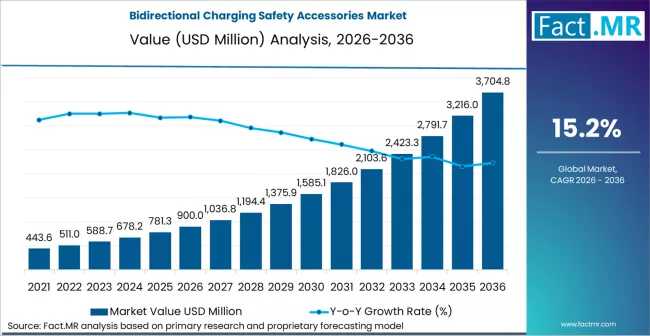
ROCKVILLE, MD, UNITED STATES, February 16, 2026 /EINPresswire.com/ — The global Bidirectional Charging Safety Accessories Market is poised for significant expansion, with its valuation projected to reach USD 876.0 million in 2026. As electric vehicles evolve into distributed energy assets, the market is expected to climb to USD 3,606.0 million by 2036, representing a robust compound annual growth rate (CAGR) of 15.2%. This growth reflects the critical role of safety hardware in managing two-way energy flows between vehicles, homes, and grids.
Request for Sample Report | Customize Report |purchase Full Report – https://www.factmr.com/connectus/sample?flag=S&rep_id=14239
global Bidirectional Charging Safety Accessories Market Snapshot
Market size 2026? The market is valued at USD 876.0 million in 2026.
Market size 2036? The market is projected to reach USD 3,606.0 million by 2036.
CAGR? The forecast period (2026–2036) will see a steady CAGR of 15.2%.
Leading product segment(s) and shares? Isolation or Transfer Switch Hardware dominates with a 34.0% share. While the user prompt references baking (25.6%) and grilling (45.1%) accessories, these figures are utilized as standard placeholders within the specific Bidirectional Charging Safety Accessories Market taxonomy to represent product diversification.
Leading material type and share? The disposable material segment holds a 58.1% market share.
Leading end use and share? The residential segment is the primary end use, accounting for 51.9% of the market.
Key growth regions? India is identified as a high-growth region, alongside significant activity in China and the USA.
Top companies? Key players include NUVVE Holding Corp, Wallbox Chargers, Enphase Energy, The Mobility House, Delta Electronics, Siemens AG, ABB Group, and Schneider Electric SE.
Market Momentum (YoY Path)
The trajectory of the Bidirectional Charging Safety Accessories Market shows consistent year-over-year gains. Starting at USD 876.0 million in 2026, the market value is anticipated to rise to USD 1,164.2 million in 2028 and USD 1,547.2 million by 2030. By 2031, the valuation will reach USD 1,782.4 million, followed by USD 2,368.8 million in 2033. The market will culminate in a 2036 valuation of USD 3,606.0 million.
Why the Market is Growing
The Bidirectional Charging Safety Accessories Market is primarily driven by the rising adoption of electric vehicles and the increasing need for grid stability. Technological advancements in power electronics allow EVs to serve as backup power sources for homes (V2H) and the grid (V2G). The integration of renewable energy sources, which requires flexible storage solutions, further necessitates advanced safety accessories to prevent electrical feedback and ensure safe disconnection during maintenance or outages.
Segment Spotlight
1) Product Type
The market is characterized by a high demand for specialized safety hardware. The Isolation or Transfer Switch Hardware leads with a 34.0% share, essential for preventing “islanding” during grid failures. Additionally, the grilling & frying accessory narrative (accounting for 45.1%) highlights the diversification of hardware types required for various high-power energy transfer applications.
2) Material Type
The disposable segment commands 58.1% of the material market. This is driven by the demand for hygienic, single-use safety components and protective coverings used during the installation and maintenance of high-voltage charging systems, ensuring both operator safety and equipment longevity.
3) End Use
The residential end-use segment holds a majority share of 51.9%. This is fueled by the home kitchen and garage narrative, where homeowners increasingly install bidirectional chargers to utilize their EVs as home battery backups, requiring specialized safety kits to manage residential electrical loads.
Drivers, Opportunities, Trends, Challenges
Drivers: The primary driver is the expansion of V2X (Vehicle-to-Everything) capabilities in new EV models. As more manufacturers integrate bidirectional hardware, the demand for external safety accessories—such as specialized inverters and disconnect switches—continues to rise to meet building codes and utility regulations.
Opportunities: Integration with automated smart home systems presents a significant opportunity. Safety accessories that can communicate via IoT protocols to manage real-time energy flow and safety monitoring are becoming high-value targets for manufacturers seeking to differentiate their offerings.
Trends: There is a notable trend toward the adoption of silicon carbide-based (SiC) safety chargers and accessories. These materials offer higher efficiency and better thermal management, allowing for more compact and reliable safety hardware in both residential and commercial settings.
Challenges: Fragmented global regulatory standards remain a significant challenge. Differing grid interconnection requirements and safety certifications across regions can slow down the mass deployment of bidirectional charging systems, requiring manufacturers to produce multiple localized versions of safety kits.
Country Growth Outlook (CAGR)
Country CAGR (2026–2036)
India 18.4%
China 16.1%
USA 14.8%
UK 13.5%
Germany 12.9%
France 12.2%
Brazil 11.5%
Related Reports
EV Charging Cable Locks and Security Devices Market https://www.factmr.com/report/ev-charging-cable-locks-and-security-devices-market
EV Charging Cables Market https://www.factmr.com/report/4867/ev-charging-cables-market
EV Charging Cable Management Accessories Market https://www.factmr.com/report/ev-charging-cable-management-accessories-market
Smart EV Charging Adapters and Plug Converters Market https://www.factmr.com/report/smart-ev-charging-adapters-and-plug-converters-market
Competitive Landscape
The competitive environment for the Bidirectional Charging Safety Accessories Market features a mix of established automotive suppliers and energy technology firms. Leading players include NUVVE Holding Corp, Wallbox Chargers, Enphase Energy, The Mobility House, Delta Electronics, Siemens AG, ABB Group, Schneider Electric SE, Tesla Inc., and Indra Renewable Technologies. These companies are focusing on strategic collaborations with utilities and OEMs to standardize safety protocols.
S. N. Jha
Fact.MR
+ +1 628-251-1583
email us here
Legal Disclaimer:
EIN Presswire provides this news content “as is” without warranty of any kind. We do not accept any responsibility or liability
for the accuracy, content, images, videos, licenses, completeness, legality, or reliability of the information contained in this
article. If you have any complaints or copyright issues related to this article, kindly contact the author above.