DC fast charging holds approximately 42% of EV Charging Station Market revenue, reflecting premium unit costs and growing highway-corridor demand.
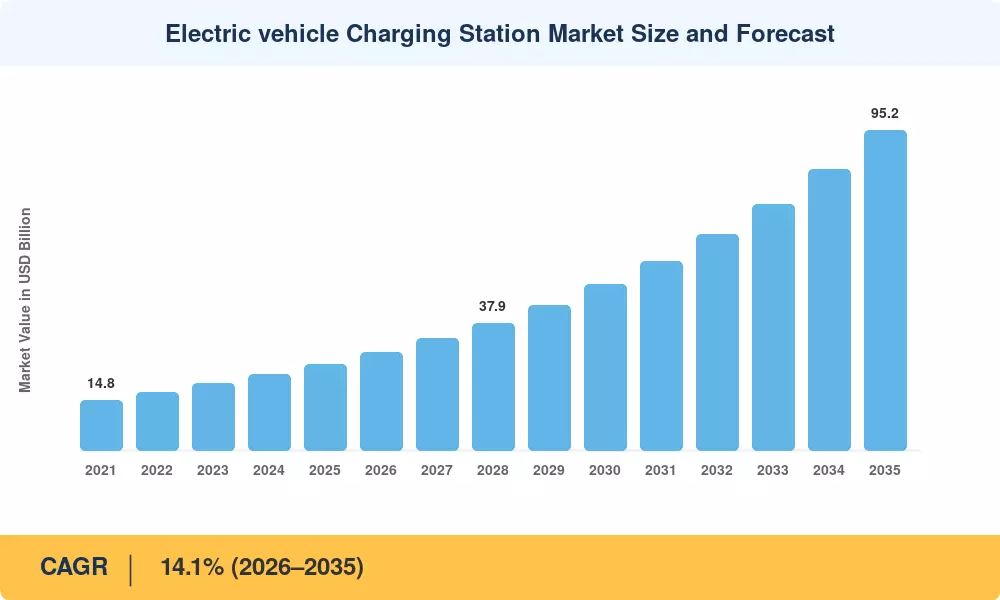
NEW YORK, NY, UNITED STATES, August 26, 2026 /EINPresswire.com/ — According to Market Research Future, the EV Charging Station Market is projected to reach USD 95.2 billion by 2035, registering a CAGR of 14.1% during the forecast period, driven by the accelerating adoption of electric vehicles worldwide and supportive government initiatives promoting sustainable transportation infrastructure. This substantial market expansion reflects the critical role that charging infrastructure plays in enabling the global transition toward electrified mobility, as automakers, governments, and energy providers collaborate to build robust, accessible, and intelligent charging networks that address range anxiety and support the growing EV ecosystem.
Market Overview
EV charging stations serve as the foundational infrastructure that powers electric vehicles by supplying electrical energy for battery recharging. These stations range from basic residential charging units to high-power public charging hubs capable of delivering rapid charging for long-distance travel. The market encompasses a diverse array of hardware, software, and service solutions that collectively form the EV charging ecosystem, including charging equipment, network management platforms, payment systems, and energy management solutions.
The key growth drivers propelling this market forward include the exponential growth in electric vehicle sales across all vehicle segments, which directly correlates with increasing demand for accessible and reliable charging infrastructure. Government policies and regulations worldwide are mandating the deployment of public charging networks, with many countries setting ambitious targets for charging station installations as part of their climate action commitments. Environmental concerns and rising fuel costs are accelerating consumer preference for electric vehicles, further fueling the demand for charging infrastructure. Additionally, technological advancements in battery technology and charging speeds are making EVs more practical for everyday use, consequently increasing the need for convenient charging options.
Technological developments are reshaping the EV charging landscape at a remarkable pace. Ultra-fast DC chargers capable of delivering 350 kW or more are becoming increasingly common, enabling charge times of under 20 minutes for many modern EVs. Smart charging technologies are emerging that optimize charging schedules based on grid load, electricity pricing, and renewable energy availability, creating more efficient and sustainable charging solutions. Bidirectional charging and vehicle-to-grid technologies are enabling EVs to serve as mobile energy storage units, contributing to grid stability and offering potential revenue streams for EV owners. Wireless induction charging technologies are advancing, promising convenient automated charging without physical cable connections.
📍 Get Free Sample Report for Detailed Market Insights:
https://www.marketresearchfuture.com/sample_request/5401
Market Segmentation
The EV charging station market is segmented based on charger type, application, ownership model, connector standard, and regional analysis to provide comprehensive insights into industry dynamics.
By Charger Type: The market is divided into DC Fast Charging, Level 2 AC Charging, and Level 1 AC Charging. DC Fast Charging represents the fastest-growing segment, offering high-power charging capabilities that significantly reduce charging times, making long-distance EV travel practical. These chargers are primarily deployed along highways and at commercial locations, with power outputs ranging from 50 kW to over 350 kW. Level 2 AC Charging serves as the most common public and residential charging solution, delivering 7 kW to 22 kW of power and typically requiring several hours for a full charge. These chargers are widely installed at workplaces, shopping centers, hotels, and residential parking areas. Level 1 AC Charging, which utilizes standard household electrical outlets, provides the slowest charging rates of 1.4 kW to 1.9 kW and is primarily used for overnight charging at homes where no dedicated charging equipment is installed.
By Application: The market is categorized into Commercial, Residential, and Public Transit segments. Commercial applications encompass charging stations installed at retail locations, office buildings, hotels, and other business facilities, catering to employees, customers, and fleet vehicles. This segment is experiencing significant growth as businesses recognize the competitive advantage of offering EV charging amenities and the potential for generating ancillary revenue. Residential applications include charging solutions for single-family homes and multifamily housing complexes, representing the largest volume segment as individual EV owners require convenient home charging access. Public Transit applications include charging infrastructure for public buses, taxis, and other municipal transportation fleets, with rapid charging requirements and dedicated depot charging installations.
By Ownership Model: The market is classified into Operator-Owned (Charge Point Operator), Site-Host Owned, and Utility-Owned models. Operator-Owned models involve companies that deploy and manage charging networks, offering services to EV drivers and generating revenue through charging fees, subscription models, and advertising. Site-Host Owned models involve property owners, businesses, and individuals who own and operate charging stations primarily for their own use or as an amenity for customers and visitors. Utility-Owned models represent a growing segment where power utilities invest in charging infrastructure as part of grid modernization efforts, integrating charging stations with grid management systems and renewable energy integration.
By Connector Standard: The market is segmented into CCS (Combined Charging System), NACS (North American Charging Standard), CHAdeMO, Type 2 (IEC 62196), and GB/T (China). CCS has emerged as the dominant standard in Europe and North America, combining AC and DC charging capabilities in a single connector. NACS, developed by Tesla, is gaining significant market share following the adoption by major automakers and charging network providers, simplifying the charging experience in North America. CHAdeMO remains prevalent in Japanese vehicles and certain Asian markets, offering DC fast charging capabilities. Type 2, also known as Mennekes, serves as the standard connector for AC charging in Europe, compatible with most European-manufactured EVs. GB/T serves as the mandatory standard for EVs sold in the Chinese market, representing the largest EV market globally and driving substantial demand for compatible charging equipment.
By Region: The market covers North America, Europe, South America, Asia Pacific, and the Middle East and Africa. Asia Pacific leads the global market, driven by China’s massive EV adoption and aggressive charging infrastructure deployment, along with strong growth in Japan, South Korea, and India. Europe follows closely with comprehensive regulatory frameworks and ambitious national targets, while North America shows rapid growth fueled by federal investment and increasing EV adoption across all vehicle segments.
🛒 You can buy this market report at:
https://www.marketresearchfuture.com/checkout?currency=one_user-USD&report_id=5401
Regional Analysis
North America is experiencing rapid expansion in the EV charging station market, driven by substantial federal investment, state-level mandates, and increasing consumer adoption of electric vehicles. The United States leads the region with the Bipartisan Infrastructure Law allocating USD 7.5 billion for EV charging infrastructure deployment, targeting the creation of a national network of 500,000 charging stations by 2030. California remains the frontrunner in EV adoption and charging infrastructure development, supported by aggressive zero-emission vehicle mandates and significant investments in public charging networks. The adoption of the NACS connector standard by major automakers and charging network providers is simplifying the charging experience and accelerating infrastructure deployment across the region. Canada is also witnessing substantial growth, with federal mandates requiring all new vehicle sales to be zero-emission by 2035 and matching investments in charging infrastructure.
Europe continues to lead in EV charging infrastructure density and regulatory support, with the European Union’s Alternative Fuels Infrastructure Regulation requiring member states to establish charging points at regular intervals along major transportation corridors. The United Kingdom stands out with ambitious targets and significant investment in both public and private charging networks, while Germany, France, and the Netherlands represent major markets with comprehensive charging networks and strong government support. The Scandinavian countries demonstrate the highest per capita charging infrastructure deployment, driven by early EV adoption and supportive policies. European automakers are investing heavily in charging network partnerships and innovative charging solutions, contributing to the region’s market leadership.
Asia Pacific dominates the global EV charging station market, with China leading the world in both EV adoption and charging infrastructure deployment. China’s state-owned utilities and private enterprises are aggressively expanding charging networks to support the world’s largest EV fleet, with millions of charging points installed nationwide. Japan and South Korea represent mature markets with sophisticated charging infrastructure, while India is emerging as a significant growth market driven by government initiatives and increasing EV adoption. Southeast Asian nations like Thailand, Indonesia, and Malaysia are developing their charging infrastructure in parallel with EV manufacturing investments, representing substantial growth potential.
South America and the Middle East and Africa represent developing markets with emerging growth potential. Brazil, the region’s largest automotive market, is gradually developing EV charging infrastructure to support growing EV adoption and government incentives. The Middle East is witnessing strategic investment in charging infrastructure as countries diversify their economies and embrace sustainable transportation solutions. The United Arab Emirates and Saudi Arabia are leading charging network deployment, while African markets remain in early stages with significant growth potential as EV adoption accelerates.
Competitive Landscape and Key Players
The EV charging station market is characterized by intense competition among established infrastructure providers, automotive manufacturers, energy companies, and technology startups. Key players are pursuing diverse strategies including vertical integration, strategic partnerships, technology innovation, and geographic expansion to strengthen their market positions.
Major companies operating in this space include ChargePoint Holdings, Tesla Inc., Shell New Energies, ABB Ltd., Siemens AG, EVBox Group, Blink Charging, Tritium, Delta Electronics, and Wallbox. These industry leaders are investing heavily in technological innovation to develop faster, more efficient, and more intelligent charging solutions that meet evolving consumer expectations and regulatory requirements.
Strategic partnerships and collaborations are reshaping the competitive landscape, with automakers entering into exclusive agreements with charging network providers to offer integrated charging solutions to their customers. Energy companies are expanding their EV charging operations, leveraging their extensive real estate networks and energy distribution expertise. Technology companies are entering the market with innovative software platforms, payment solutions, and energy management systems that enhance the charging experience and optimize grid integration. The evolution of the Electric Vehicle Charging Infrastructure Market is fundamentally linked to the growth of charging stations, as comprehensive infrastructure networks are essential for supporting widespread EV adoption and enabling long-distance electric travel across all regions.
Innovation and technology initiatives are accelerating across the industry, with companies developing high-power charging stations exceeding 350 kW, integrated battery storage solutions to reduce peak demand charges, and artificial intelligence-driven predictive maintenance systems. Software platforms are becoming increasingly sophisticated, offering features such as real-time availability monitoring, dynamic pricing, smart charging scheduling, and seamless roaming between charging networks. Charging station manufacturers are developing modular designs that allow easy scalability and future upgrades to meet changing power requirements and technology standards.
Latest Industry News and Developments
Recent industry developments highlight the dynamic evolution of the EV charging station market and the intensifying competition among major players to capture market share. A prominent global energy company recently announced plans to install thousands of high-power charging points across Europe, North America, and Asia, partnering with major automakers to provide exclusive charging services for premium electric vehicle owners.
Another significant development involves a leading EV manufacturer expanding its proprietary charging network and opening it to vehicles from other brands, significantly increasing charging availability and accelerating the adoption of the NACS connector standard across the industry. This strategic move is reshaping the competitive landscape and driving standardization efforts that benefit all EV drivers.
In the technology innovation segment, a major charging equipment manufacturer unveiled a new generation of ultra-fast charging stations featuring advanced liquid-cooled cables, modular power architecture, and integrated energy storage capabilities. These new stations are designed to deliver consistent high-power charging while managing grid demand and reducing installation costs, setting new performance standards for public charging infrastructure.
Market Challenges and Opportunities
The EV charging station market faces several significant challenges that require strategic solutions for sustainable growth. High infrastructure costs remain a primary barrier, particularly for ultra-fast DC charging installations that require substantial electrical grid upgrades and expensive equipment. Grid capacity constraints in many urban areas limit the deployment of high-power charging stations, requiring sophisticated load management solutions and grid upgrades. Standardization challenges persist across different regions and connector types, complicating the charging experience for EV drivers and creating compatibility concerns.
Technology-driven possibilities include the integration of renewable energy sources with charging stations, enabling green charging and reduced carbon footprints. Vehicle-to-grid and bidirectional charging technologies offer opportunities for new business models and grid services, potentially creating revenue streams for charging station owners and EV drivers. Battery storage integration with charging stations provides opportunities for peak demand management, grid stabilization, and improved charging economics. The Electric Vehicle Busbar Market is playing an increasingly important role in this ecosystem, as efficient power distribution systems are critical for managing the high currents and power levels required in fast-charging stations, enabling more compact and cost-effective charging infrastructure designs.
Future growth potential remains exceptionally strong, driven by the exponential growth of EV sales, supportive government policies, and technological innovations that make EV ownership more practical and convenient. As charging technology continues to advance and costs decline, EV charging stations will become increasingly accessible and integrated into everyday environments, from streetlights and parking meters to shopping centers and office buildings, creating a seamless charging experience that supports the widespread adoption of electric mobility.
To explore more market insights, visit us at:
https://www.marketresearchfuture.com/reports/electric-vehicle-charging-station-market-5401
The EV charging station market represents a fundamental component of the global energy transition and will play a central role in shaping the future of transportation. As investment continues to flow into this sector and technology advances, EV charging will become increasingly invisible and integrated into daily life, supporting sustainable mobility for future generations and contributing to reduced carbon emissions across the transportation sector.
More Related Reports from MRFR Library:
India EBike Market : https://www.marketresearchfuture.com/reports/india-ebike-market-21369
Europe Automotive Wiring Harness Market : https://www.marketresearchfuture.com/reports/europe-automotive-wiring-harness-market-21371
Europe Electric Vehicle Battery Recycling Market : https://www.marketresearchfuture.com/reports/europe-electric-vehicle-battery-recycling-market-21373
United States Car Parts Aftermarket Market : https://www.marketresearchfuture.com/reports/united-states-car-parts-aftermarket-market-21375
Taxi Market : https://www.marketresearchfuture.com/reports/taxi-market-21383
Off Highway Vehicle Door Closures Market : https://www.marketresearchfuture.com/reports/off-highway-vehicle-door-closures-market-21431
India Electric Rickshaw Market : https://www.marketresearchfuture.com/reports/india-electric-rickshaw-market-21449
Airbag Textile Market : https://www.marketresearchfuture.com/reports/airbag-textile-market-21454
Europe Automobile Industry Market : https://www.marketresearchfuture.com/reports/europe-automobile-industry-market-21551
Luxury Cars Market : https://www.marketresearchfuture.com/reports/luxury-cars-market-21578
Market Research Future
Market Research Future
+1 855-661-4441
email us here
Legal Disclaimer:
EIN Presswire provides this news content “as is” without warranty of any kind. We do not accept any responsibility or liability
for the accuracy, content, images, videos, licenses, completeness, legality, or reliability of the information contained in this
article. If you have any complaints or copyright issues related to this article, kindly contact the author above.

Media gallery