Europe generated USD 4.05 billion in 2025, with retrofit and re-cladding work supplying an unusually high share of Sandwich Panel Market volume
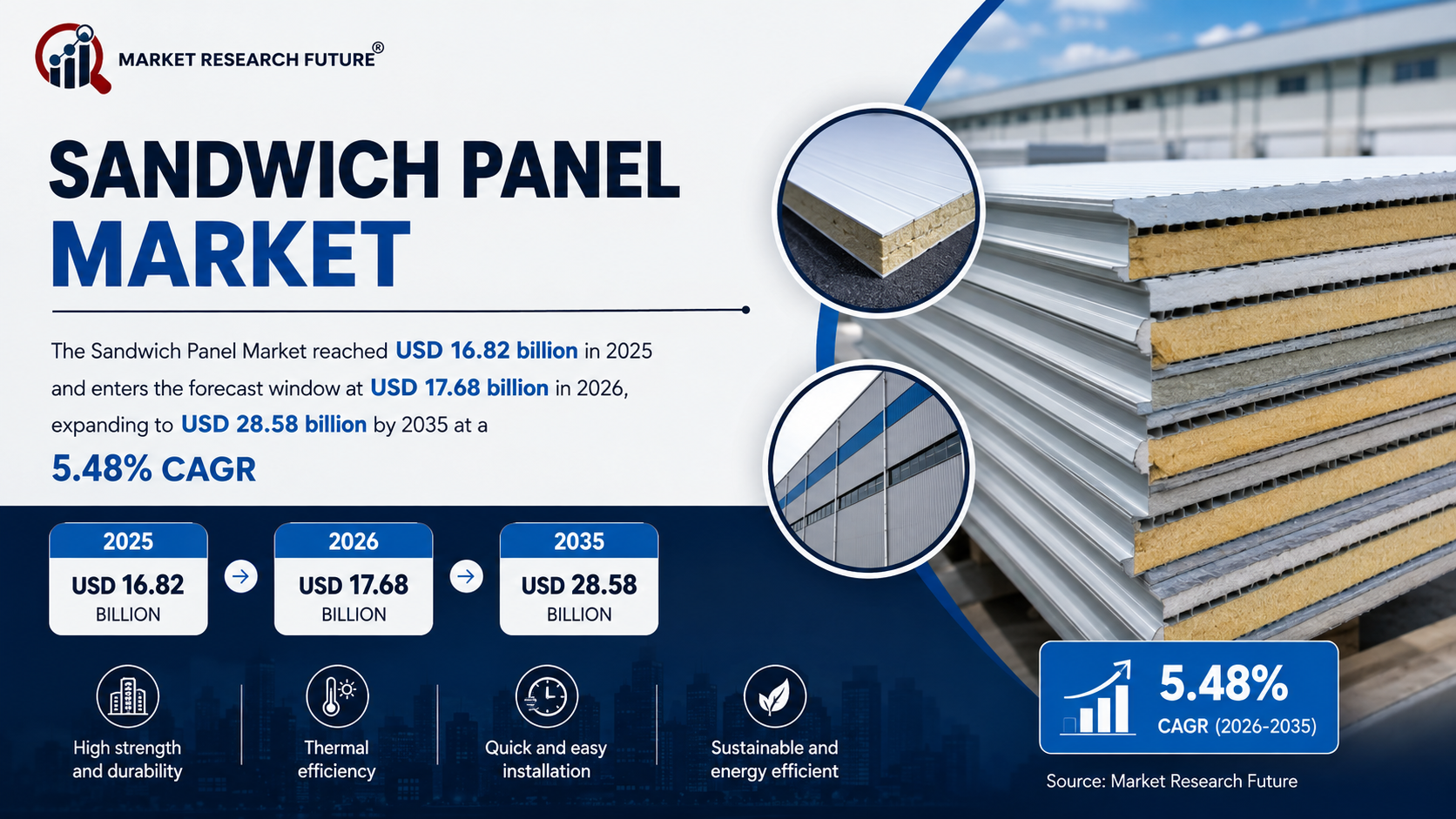
OR, UNITED STATES, September 2, 2026 /EINPresswire.com/ — The global Sandwich Panel Market is entering a strong growth phase as construction companies increasingly prioritize faster installation, energy efficiency, fire performance, and lower lifecycle costs. According to the latest Market Research Future Sandwich Panel Market report, the market reached USD 16.82 billion in 2025 and is projected to expand to USD 28.58 billion by 2035, registering a 5.48% CAGR during 2025–2035. The market is forecast to reach approximately USD 17.68 billion in 2026.
Sandwich panels are increasingly being selected as prefabricated building-envelope systems because they combine insulation, structural performance, and finishing into a single factory-produced component. This makes them particularly attractive for industrial buildings, warehouses, cold-storage facilities, commercial properties, and other projects where construction speed and thermal performance are critical.
Sandwich Panel Market Growth Drivers
One of the strongest growth drivers is the expansion of cold-chain infrastructure. Refrigerated warehouses and food-processing facilities require highly insulated building envelopes, creating demand for thicker PUR and PIR panels. The report identifies cold chain and food processing as the fastest-growing end-user sector, with a 6.41% CAGR through 2035. Growing requirements for pharmaceutical distribution, food preservation, and temperature-controlled logistics are supporting this expansion.
Another major driver is the rapid development of hyperscale data centers. Data-center projects require controlled environments, fast construction schedules, thermal insulation, and increasingly stringent fire-performance specifications. Sandwich panels allow developers to accelerate enclosure work while meeting insulation and acoustic requirements.
Energy-efficiency regulations are also supporting demand. Stricter building-envelope standards are encouraging developers to use systems that provide improved thermal performance without significantly increasing construction complexity. The European Union’s building-performance requirements and energy-efficiency initiatives are particularly important for renovation and re-cladding projects.
Construction labor shortages represent another structural opportunity. Factory-produced sandwich panels shift a significant portion of construction activity from the job site to controlled manufacturing facilities. This can reduce installation time and help contractors manage labor availability more efficiently.
Request Free Sample Copy: https://www.marketresearchfuture.com/sample_request/1563
Rising Demand for Industrial and Commercial Buildings
Industrial buildings remain the largest end-user sector in the Sandwich Panel Market, accounting for 42.9% of end-use demand in 2025. Warehouses, logistics centers, factories, and light-manufacturing facilities rely heavily on insulated panels because rapid enclosure can accelerate the overall project schedule.
Commercial buildings generated USD 4.44 billion in 2025. Demand in this segment is being influenced by retail facilities, offices, hospitality properties, and especially data-center construction.
The continued expansion of e-commerce and organized logistics is also increasing warehouse construction. Sandwich panels offer a combination of insulation, durability, and rapid installation that suits large-scale distribution facilities.
Cold Chain Becomes a High-Growth Application
Cold-chain infrastructure is emerging as one of the most attractive opportunities for sandwich panel manufacturers. Temperature-controlled facilities require strong thermal barriers and airtight construction to minimize energy losses.
The market report indicates that cold chain and food processing will grow at a 6.41% CAGR from 2026 to 2035, making it the fastest-growing end-user sector. Pharmaceutical logistics, frozen food distribution, fresh produce storage, and meat and dairy processing are among the areas supporting demand.
This trend is particularly significant across Asia-Pacific and the Middle East, where investments in modern food infrastructure and refrigerated logistics are expanding.
Polyurethane Remains the Leading Core Material
By core material, polyurethane (PUR) remains the leading category, generating approximately USD 6.48 billion in revenue in 2025 and accounting for about 38.5% of market share. PUR provides a strong balance between thermal performance, weight, and cost, making it widely used across industrial and commercial construction.
Expanded polystyrene (EPS) remains important in cost-sensitive applications, particularly warehouses and agricultural structures. However, tighter energy-performance requirements can favor higher-performance insulation materials.
Mineral and rock wool are gaining importance where fire resistance is a primary consideration. The segment is projected to grow at a 5.92% CAGR through 2035. PIR occupies another important position, particularly in applications requiring strong thermal performance and improved fire characteristics.
Aluminium and Steel Dominate Panel Skins
Aluminium accounted for 42.1% of sandwich panel skin-material share in 2025, supported by corrosion resistance and a broad range of architectural finishes. Aluminium is particularly valuable in environments where moisture and chemical exposure create durability concerns.
Steel remains a major material because of its structural rigidity, availability, and competitive delivered cost. Steel panels are extensively used in warehouses, industrial facilities, agricultural buildings, and manufacturing plants.
At the same time, continuous fibre-reinforced thermoplastics (CFRT) are emerging as a growth opportunity. The report forecasts a 5.64% CAGR for CFRT through 2035, supported by interest in lower embodied carbon, recyclability, and lightweight construction.
Buy Now: https://www.marketresearchfuture.com/checkout?currency=one_user-USD&report_id=1563
Continuous Lamination Strengthens Manufacturing Efficiency
Continuous lamination accounted for 69.9% of installed production capacity in 2025, making it the dominant manufacturing technology. Continuous production allows manufacturers to improve consistency, reduce material waste, and maintain tight thickness tolerances.
Discontinuous pressing remains important for specialized applications, particularly shorter production runs, mineral-wool panels, and customized profiles. The segment is projected to grow at a 4.61% CAGR through 2035.
The growing adoption of automated production lines is also helping manufacturers improve quality control. Inline density monitoring, thermal inspection, and predictive maintenance are becoming increasingly relevant as customers demand consistent product performance.
Wall Panels Lead the Application Segment
Wall panels represented 40.8% of application revenue in 2025, making them the largest application category. Their popularity is linked to the large surface area of industrial and commercial building envelopes and their ability to combine insulation with exterior finishing.
Roof panels generated USD 4.76 billion in 2025. These systems provide weather protection and insulation while reducing the number of separate construction layers required.
Insulated panels used for partitions, ceilings, and cold rooms are also gaining traction, with this category forecast to grow at a 6.09% CAGR between 2026 and 2035.
Asia-Pacific Leads the Global Market
Asia-Pacific accounted for 46.4% of global Sandwich Panel Market revenue in 2025, making it the dominant regional market. The region benefits from large-scale industrial construction, warehouse development, cold-chain expansion, and manufacturing investment.
China generated approximately USD 3.48 billion in 2025, supported by industrial construction and prefabrication initiatives. India is another high-growth market, with the report projecting a 7.34% CAGR through 2035. Warehousing, cold-chain infrastructure, and manufacturing investment are important contributors to India’s demand.
ASEAN is also expected to grow rapidly, with a projected 6.88% CAGR, supported by foreign direct investment and industrial-park development.
Europe accounted for 24.1% of global revenue in 2025. The region is seeing demand from energy-efficiency renovations, fire-safety remediation, and industrial retrofits. North America represented 18.2%, with data centers, manufacturing reshoring, and distribution facilities supporting demand.
Re-Cladding and Retrofit Create New Opportunities
The retrofit market represents an important long-term opportunity for sandwich panel manufacturers. Many older industrial buildings have outdated thermal envelopes and require upgrades to meet modern energy-performance requirements.
Lightweight panel overlays can improve insulation without requiring extensive structural modifications. This creates an attractive alternative to heavier masonry or precast solutions.
Europe is particularly promising because energy-efficiency regulations are encouraging renovation of inefficient non-residential buildings. Re-cladding can therefore become an important source of recurring demand alongside new construction.
Sustainability and Circularity Gain Importance
Sustainability is becoming increasingly important in building-material procurement. Developers and contractors are paying greater attention to embodied carbon, recyclability, environmental product declarations, and material traceability.
Manufacturers are responding through low-carbon aluminium, recycled-content cores, thermoplastic facings, and improved end-of-life recovery systems. CFRT is particularly attractive because its thermoplastic characteristics can support separation and recycling at the end of a building’s useful life.
The market is also moving toward digital material information, including BIM-ready product data and environmental documentation. Suppliers able to provide verified product-level sustainability information may gain an advantage in institutional and public-sector projects.
Challenges Facing the Sandwich Panel Market
Despite strong growth prospects, the market faces several challenges. Steel and chemical feedstock price volatility can affect manufacturing costs and margins. Coated steel and chemical inputs represent significant portions of panel production costs, making manufacturers sensitive to commodity-price movements.
Fire-performance regulations are another challenge. Combustible cores such as PUR and EPS face restrictions in certain high-rise and high-occupancy applications. This is encouraging substitution toward mineral wool and hybrid core technologies.
Regulations concerning blowing agents are also influencing foam chemistry. Manufacturers must increasingly adopt lower-impact blowing-agent technologies while maintaining required thermal and fire performance.
A shortage of certified installation crews and logistical limitations associated with transporting long panels can create additional challenges, particularly in dense urban construction environments.
Report Summary: https://www.marketresearchfuture.com/reports/sandwich-panel-market-1563
Competitive Landscape
The Sandwich Panel Market includes major building-material and steel companies competing through product innovation, production capacity, geographic expansion, and sustainability solutions.
Key players identified in the latest MRFR report include Kingspan Group, ArcelorMittal, Assan Panel, Metecno Group, Tata Steel, and Isopan.
Companies are increasingly focusing on fire-rated products, high-performance insulation cores, low-carbon materials, automated manufacturing, and digital product documentation. Manufacturers that can combine consistent quality with short lead times and verified environmental performance are likely to strengthen their competitive positions.
Future Outlook
The Sandwich Panel Market is expected to maintain steady growth through 2035 as construction moves toward greater prefabrication, energy efficiency, and faster project delivery. The market’s expansion from USD 16.82 billion in 2025 to USD 28.58 billion by 2035 at a 5.48% CAGR reflects the increasing role of high-performance building envelopes.
Cold-chain facilities and hyperscale data centers are expected to remain particularly important sources of incremental demand. At the same time, industrialization in Asia-Pacific, Gulf construction projects, warehouse expansion, and European retrofit programs will create additional opportunities.
Future competition will increasingly depend on more than panel volume. Fire certification, thermal performance, embodied-carbon disclosure, recyclable materials, digital product data, and manufacturing automation are likely to become critical differentiators.
Related Report
composite sandwich panel market https://www.marketresearchfuture.com/reports/composite-sandwich-panel-market-24705
Steel Sandwich Panels Market https://www.marketresearchfuture.com/reports/steel-sandwich-panels-market-7548
Mineral Wool Steel Sandwich Panel Market https://www.marketresearchfuture.com/reports/mineral-wool-steel-sandwich-panel-market-10869
non honeycomb sandwich panel core material market https://www.marketresearchfuture.com/reports/non-honeycomb-sandwich-panel-core-material-market-30301
multi metal aluminum sandwich panel market https://www.marketresearchfuture.com/reports/multi-metal-aluminum-sandwich-panel-market-30854
Market Research Future
Market Research Future
+1 855-661-4441
email us here
Legal Disclaimer:
EIN Presswire provides this news content “as is” without warranty of any kind. We do not accept any responsibility or liability
for the accuracy, content, images, videos, licenses, completeness, legality, or reliability of the information contained in this
article. If you have any complaints or copyright issues related to this article, kindly contact the author above.

Media gallery