Sensor Patch Market Size, Share and Research Report By Product Type (Blood Glucose, Blood Oxygen, ECG, Temperature, Heart Rate, Blood Pressure, Hydration
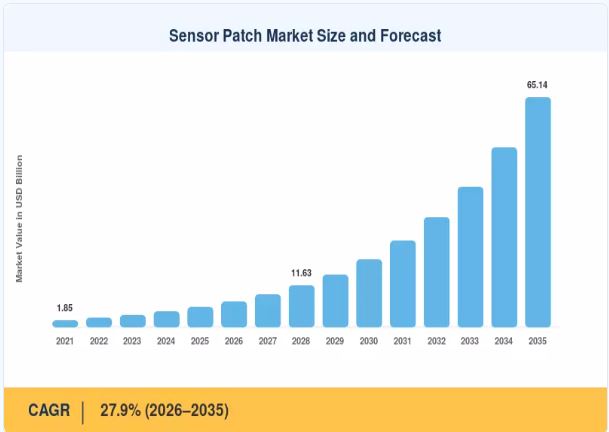
NEW YORK,, NY, UNITED STATES, September 21, 2026 /EINPresswire.com/ — The Global Sensor Patch market reached USD 5.56 billion in 2025 and enters the forecast window at USD 7.11 billion in 2026, climbing to USD 65.14 billion by 2035 at a 27.9% CAGR. Two catalysts anchor that trajectory. The first is payer policy: U.S. Medicare reimbursement for remote physiologic monitoring now covers device supply, setup, and clinician review under a codified fee schedule, converting adhesive sensors from a cash-pay novelty into a billable clinical service.
The second is regulatory throughput, the FDA cleared its expanded continuous glucose platform approvals in late 2024, shortening the runway for successor devices. The market’s 27.9% CAGR reflects the convergence of chronic disease prevalence and glucose care pathways (+6.8% impact), payer reimbursement expansion (+5.9% impact), flexible and printed electronics cost decline (+4.7% impact), and accelerated regulatory pathways (+3.9% impact) accelerating across the world’s largest chronic-care and payer-reimbursement economies simultaneously.
Sensor patches are compact, lightweight, and increasingly flexible devices that can be attached to the skin or integrated into wearable systems to collect physiological, environmental, or activity-related information. Their ability to support continuous and real-time monitoring is increasing their relevance across healthcare, fitness, sports, wellness, industrial safety, and research applications. Advances in miniaturized electronics, flexible materials, wireless connectivity, biosensing, and low-power semiconductor technologies are improving the functionality of sensor patches.
At the same time, growing interest in remote patient monitoring, preventive healthcare, personalized wellness, and data-driven decision-making is encouraging adoption. Compared with conventional monitoring equipment, sensor patches can provide greater mobility and convenience while reducing the need for bulky equipment. The combination of portability, connectivity, continuous measurement, and increasing sensor intelligence is expected to create substantial opportunities for manufacturers and technology providers.
Get Full PDF Sample Copy of Report: (Including Full TOC, List of Tables & Figures, Chart) @
https://www.marketresearchfuture.com/sample_request/4127
➤ Key Sensor Patch Market Growth Drivers:
The growing demand for continuous health and wellness monitoring is one of the major factors supporting the sensor patch market. Consumers increasingly want convenient technologies that can provide information about physical activity, sleep, recovery, and other wellness indicators without interrupting daily routines. Healthcare providers are also exploring remote monitoring technologies that allow selected patient information to be observed outside traditional clinical settings. The increasing prevalence of chronic diseases and the need for long-term monitoring can further support demand for convenient wearable technologies.
Another important driver is the rapid development of flexible and wearable electronics. Flexible sensors can conform more effectively to the human body, potentially improving comfort and signal collection. Miniaturization is also enabling manufacturers to integrate greater functionality into smaller devices. Meanwhile, improvements in wireless communication and cloud computing are making it easier to transmit and process sensor data. The integration of artificial intelligence and analytics can provide additional value by identifying patterns and converting raw measurements into actionable insights.
➤ What Does the Future Hold for the Sensor Patch Market?
Chronic disease prevalence and glucose care pathways contribute approximately 6.8 percentage points to the sensor patch market’s CAGR the single highest driver impact. Diabetes affected 589 million adults worldwide in 2024, with projected growth to 853 million by 2050, and roughly 43% of cases remain undiagnosed. That epidemiology sustains the largest single demand pool in the market, because continuous glucose sensing is the one adhesive category with settled clinical guidelines, established coding, and physician familiarity. Hypertension adds a parallel pool, with the WHO estimating 1.28 billion adults are affected and only about one in five achieving control.
Payer reimbursement expansion contributes approximately 5.9 percentage points of driver impact, establishing coding depth as a primary structural driver. Medicare’s remote physiologic monitoring codes reimburse roughly USD 19 for device supply and USD 50 for the first 20 minutes of clinician review each month, creating predictable per-patient economics that hospital finance teams can underwrite, and commercial payers have largely mirrored the structure. Glucose and cardiac indications clear coverage easily, while temperature and hydration claims still face case-by-case adjudication, which is why product mix tracks coding decisions closely.
Flexible and printed electronics cost decline adds a further 4.7% as roll-to-roll deposition and printed photoplethysmography arrays have cut sensing-module bill-of-materials by an estimated 34% since 2021, making single-use, multi-day patches viable at consumer price points rather than only in reimbursed clinical settings. Accelerated regulatory pathways contribute a further 3.9% as the FDA’s Breakthrough Devices Program granted 145 designations in FY2024, with wearable and continuous-sensing submissions among the fastest-growing categories, reaching decision roughly 30% faster than conventional 510(k) peers, while Japan’s SAKIGAKE framework offers a comparable acceleration for domestically first-filed devices.
Get access to the full description of the report @
https://www.marketresearchfuture.com/reports/sensor-patch-market-4127
➤ Who Are the Key Players in the Sensor Patch Market?
Concentration in the sensor patch market is moderate. An estimated Herfindahl-Hirschman Index in the 900-1,100 range reflects two glucose-centric leaders with genuine scale, a cardiac specialist with a defensible protocol position, and a long tail of venture-funded platform entrants. The top five suppliers hold roughly 45-55% of global revenue, leaving meaningful room for share shifts as coverage expands beyond glucose and cardiac indications. Fragmentation is highest in fitness, hydration, and multi-analyte categories, where no supplier has yet established distribution advantage. MRFR identifies the following key participants with estimated revenue share ranges:
★ Abbott Laboratories (~14–18% share)
★ DexCom, Inc. (~11–14% share)
★ Medtronic plc (~8–11% share
★ iRhythm Technologies (~5–7% share)
★ Koninklijke Philips N.V. (~4–6% share)
★ GE HealthCare (~3–5% share)
★ Baxter International (~2–4% share)
★ VitalConnect, Inc. (~2–3% share)
★ LifeSignals, Inc. (~1–2% share)
★ Sensium Healthcare (~1–2% share)
Strategic competition in the sensor patch market is increasingly defined by adhesive wear-time evidence and gateway cybersecurity certification rather than sensor accuracy alone, with adhesive-related skin irritation and wear-time limits cited as a top structural headwind, contributing an estimated -3.6% drag on CAGR as contact dermatitis and adhesive failure remain the leading causes of early patch removal, with discontinuation clustering in the first two wear cycles and biocompatibility testing for reformulated adhesives adding nine to fifteen months to development timelines, alongside cybersecurity and health data exposure, reimbursement gaps outside glucose and cardiac indications, specialty substrate supply concentration in East Asia, and sensor drift versus clinical reference methods.
➤ What Are the Emerging Trends in the Sensor Patch Market?
Several transformational trends are redefining the sensor patch market’s evolution through 2035:
Closed-Loop Drug Delivery: Combining microneedle reservoirs with feedback-controlled dosing turns a sensor into a therapeutic device, with regulatory precedent being established for combination product routes that allow concurrent consideration of devices and biologics, making sensing chemistry standardization by pharma partners a decade-long platform-lock-in signal.
Emerging-Market Telehealth Expansion: India’s Ayushman Bharat Digital Mission has created more than 700 million health accounts, providing identity and consent plumbing that allows patch-derived data to flow into national records, with Brazil and Indonesia using similar architectures and volume economics favoring simplified single-parameter designs made locally.
Data Monetisation and Subscription Models: Hardware margins compress predictably as flexible electronics commoditize, so vendors are shifting revenue mix toward analytics subscriptions billed per monitored patient per month, while longitudinal, consented datasets also carry standalone value for pharmaceutical endpoint validation.
Decentralized Clinical Trials: Sponsors running decentralized protocols need continuous, auditable physiological capture without site visits, and adhesive patches satisfy that requirement at a fraction of site-monitoring cost, with trial supply agreements multi-year, volume-committed, and priced on validation quality rather than unit cost.
Reusable Substrates and Materials Circularity: Self-healing elastomers and detachable electronics modules allow expensive components to survive multiple adhesive changes, cutting cost per wear-day materially, with European procurement beginning to score medical device tenders on waste profile independent of price.
Buy Full Research Report:
https://www.marketresearchfuture.com/checkout?currency=one_user-USD&report_id=4127
➤ How Is the Sensor Patch Market Segmented?
The sensor patch market report provides a comprehensive segmentation framework:
By Product Type: Blood Glucose (29.0% share, 2025), Blood Oxygen (29.1% CAGR), ECG (USD 0.79 billion, 2025), Temperature (12.8% share, 2025), Heart Rate (USD 0.61 billion, 2025), Blood Pressure (7.5% share, 2025), Hydration (26.4% CAGR), Other Product Types (3.7% share, 2025)
By Application: Medical Monitoring (39.3% share, 2025), Diagnostics (USD 1.02 billion, 2025), Fitness and Sports (USD 0.90 billion, 2025), Drug Delivery and Therapeutics (29.8% CAGR), Military (6.5% share, 2025), Infant Care (25.9% CAGR), Other Applications (2.8% share, 2025)
By Wearable Type: Body-Worn and Other Wearable Types (46.6% share, 2025), Chest and Torso (29.4% CAGR), Wrist-Worn (USD 0.87 billion, 2025), Arm and Bicep (12.1% share, 2025), Ear and Neck (24.7% CAGR)
By Form Factor: Wearable Patches (dominant), Adhesive Patches, Flexible Patches, Smart Patches (fastest-growing), Disposable Patches
By Distribution Channel: Online Retail (dominant), Pharmacies (fastest-growing), Medical Supply Stores, Direct Sales, Healthcare Institutions
By Region: North America (33.1% share, 2025), Europe (USD 1.52 billion, 2025), Asia-Pacific (30.2% CAGR), South America (USD 0.38 billion, 2025), Middle East & Africa (5.8% share, 2025)
➤ What Are the Regional Insights from the Sensor Patch Market?
The United States anchors North American performance in the sensor patch market because it is the only market where device supply, setup, and clinician interpretation are separately billable, letting health systems build monitoring programs with defensible ROI models, commanding 84.6% of a region that holds 33.1% of global share.
Europe’s defining variable in the sensor patch market, which held USD 1.52 billion in 2025, is MDR. Recertification under Regulation (EU) 2017/745 has consumed notified-body capacity and forced portfolio pruning, with the European Commission acknowledging backlogs that pushed transition deadlines into 2027 for higher-risk classes, a delay that penalizes new entrants and protects incumbents with existing certificates.
Asia-Pacific converts policy into volume faster than any other region in the sensor patch market, posting the fastest regional CAGR at 30.2%. China commands 38.2% of regional share as its NMPA innovative device channel has approved a growing cohort of domestically developed continuous monitoring products, which provincial procurement then scales quickly across tiered hospital networks.
Brazil dominates the South American sensor patch market, commanding 61.3% of regional share as ANVISA’s revised device classification framework has clarified the registration route for connected wearable diagnostics, cutting a step that previously added months to launch planning, with adoption concentrated among private hospital groups in São Paulo and Rio de Janeiro marketing diabetes and cardiac monitoring programs as member differentiators.
➤➤➤ Regional & Country-Level Reports by Market Research Future:
US Sensor Patch Market –
https://www.marketresearchfuture.com/reports/us-sensor-patch-market-19721
➤➤➤ Industry Analysis Reports by Market Research Future:
3Pl Supply Chain Management Services Market
https://www.marketresearchfuture.com/reports/3pl-supply-chain-management-services-market-65802
Additive Manufacturing For Aerospace Applications Services Market
https://www.marketresearchfuture.com/reports/additive-manufacturing-for-aerospace-applications-services-market-65815
Advanced Oxidation Process Aop Water Treatment Services Market
https://www.marketresearchfuture.com/reports/advanced-oxidation-process-aop-water-treatment-services-market-65819
Advertising Agency Services Market
https://www.marketresearchfuture.com/reports/advertising-agency-services-market-65821
Agricultural Drone Services Market
https://www.marketresearchfuture.com/reports/agricultural-drone-services-market-65844
Antitrust Law Consulting Services Market
https://www.marketresearchfuture.com/reports/antitrust-law-consulting-services-market-65905
Automation Testing Services Market
https://www.marketresearchfuture.com/reports/automation-testing-services-market-65932
Automotive Hvac Services Market https://www.marketresearchfuture.com/reports/automotive-hvac-services-market-65969
Automotive Legal Services Market
https://www.marketresearchfuture.com/reports/automotive-legal-services-market-65975
Automotive Testing And Certification Market
https://www.marketresearchfuture.com/reports/automotive-testing-and-certification-market-65991
Market Research Future
Market Research Future
+1 855-661-4441
email us here
Legal Disclaimer:
EIN Presswire provides this news content “as is” without warranty of any kind. We do not accept any responsibility or liability
for the accuracy, content, images, videos, licenses, completeness, legality, or reliability of the information contained in this
article. If you have any complaints or copyright issues related to this article, kindly contact the author above.

Media gallery