Soilytix today released LOAM, a family of genomic AI models trained on long-read environmental genomes, alongside a preprint evaluating their biological performance.
This press release features multimedia. View the full release here: https://www.businesswire.com/news/home/20261001952483/en/
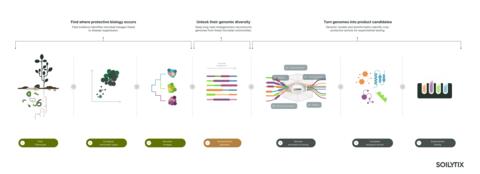
Soilytix’s bio-asset discovery platform connects field evidence with deep long-read metagenomics and genomic AI to identify and prioritise microbial genes and proteins as crop-protection candidates for experimental testing.
“Billions of years of biological R&D have occurred in the soil beneath our feet. The challenge is knowing where to look and what is worth testing,” said Tim Rajakumar, Chief Scientific Officer at Soilytix. “We use field evidence, deep sequencing and models such as LOAM to narrow that search.”
Learning biology from environmental DNA
Most genomic AI models are trained predominantly on established reference collections. Environmental metagenomics provides access to broader microbial diversity, much of it poorly characterised.
LOAM was trained on 15,640 microbial genomes reconstructed from long-read sequencing of soil, sediment and water, representing approximately 67.5 billion DNA bases.
The models were evaluated on gene essentiality, enzyme function and genetic variant effects. On an enzyme-function benchmark of experimentally annotated genes across 128 functional classes, LOAM-624M ranked first among all models evaluated, including models roughly ten times larger. Across the wider evaluation, LOAM achieved leading performance among comparably sized models and remained competitive with substantially larger models.
The results suggest long-read environmental genomes can provide useful training data for genomic AI while exposing models to biology poorly represented in conventional reference collections.
From field evidence to candidates
Soilytix is connecting these models with biological patterns observed across agricultural fields. In disease-suppressive soils, for example, a pathogen may be present while disease repeatedly fails to develop, suggesting the surrounding microbial community may contain useful biology.
Soilytix has built a permissioned dataset spanning thousands of agricultural field samples, linking microbial communities with pathogen occurrence and disease outcomes. Its laboratory can generate deep long-read genomic data from promising environments, while LOAM and established bioinformatics methods help prioritise candidate genes and proteins for testing.
The aim is to reduce a large biological search space to a smaller, better-informed shortlist for experimental screening.
“The value for a crop-protection partner isn’t access to another AI model,” said Bruno Steinkraus, Founder and CEO of Soilytix. “It is being able to start with a defined pathogen or product objective and work towards biological candidates that can actually be tested.”
Soilytix is opening a limited number of discovery pilots with crop-protection and biologicals companies for 2027.
Research release
All four LOAM models are being released for research use alongside the manuscript:
- Preprint: LOAM: A family of genomic language models
- LOAM models: LOAM – a Soilytix Collection
- Technical article: Introducing LOAM: Learning Biology from Long-Read Soil Genomes
About Soilytix
Soilytix is a Hamburg-based soil intelligence and biotechnology company combining field data, molecular analysis, long-read genomics and computational models. Its bio-asset discovery platform uses field evidence, deep sequencing and computational models to prioritise microbial candidates for experimental validation with partners.
View source version on businesswire.com: https://www.businesswire.com/news/home/20261001952483/en/
Media gallery