
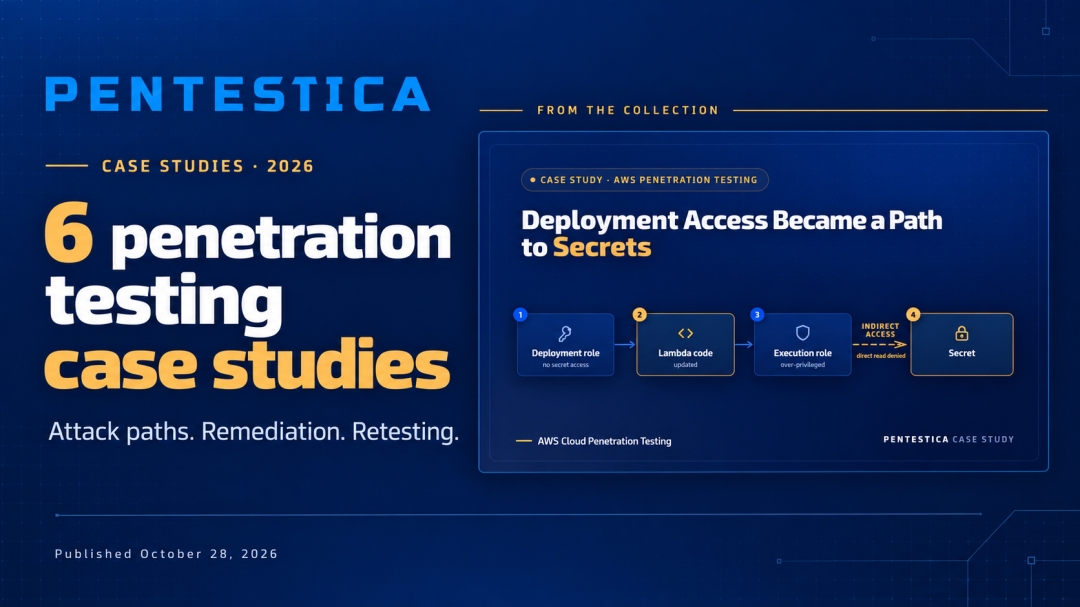
Chicago, Illinois, United States – November 2, 2026 – Pentestica has published six penetration testing case studies documenting security weaknesses, remediation and retesting across applications, cloud environments and internal infrastructure. Published on October 28, 2026, the anonymized accounts explain what testers demonstrated, where each assessment stopped and how fixes were checked.
The publication covers public application access, Android document sharing, Active Directory certificates, Amazon Web Services (AWS) permissions, webhook delivery and purchase approvals. Two cases describe initial corrections that left alternate routes open, followed by further remediation and retesting. The cases are individual company accounts, rather than a study of how frequently these issues occur across an industry.
In the external penetration testing case, a direct route to an application server bypassed a single sign-on and multifactor authentication gateway. The gateway’s own login controls held. Testers demonstrated the separate access path using an owner-created record and one agreed status change. Retesting found that the first correction had left an auxiliary port accessible before the remediation was completed.
The AWS case describes a deployment identity that could not read secrets directly but could change function code running under a more privileged role. Testers used a dedicated test function and a secret created for the assessment. Changes to deployment permissions and execution roles were followed by checks of both the demonstrated attack path and legitimate deployment activity.
A business logic case examined approved purchase orders that could still be edited without invalidating their approval. A test downstream system retrieved the changed contents. The first correction left an import route open. The final fix linked approval to the exact order version and introduced shared checks across editing paths. Testing took place in preproduction, with actual purchases excluded.
The other cases document Android file sharing, certificate enrollment in Active Directory and a webhook redirect reaching an agreed internal endpoint. Each specifies the limits of its demonstration. The Android case required another application on the same device; privileged certificate authentication was proved only in an isolated copy; and the webhook case confirmed a connection rather than extraction of internal response data.
According to the published accounts, the six assessments involved five to eight tester-days of initial testing and one to two tester-days of retesting. Client identities and sensitive technical details are withheld. The articles distinguish demonstrated impact from outcomes that were outside the agreed scope or were not established during testing.
Pentestica reports a team of 25 certified senior pentesters, more than 500 completed penetration tests and over 10 years of offensive security experience. Its testers use automated tools for discovery and coverage, then manually investigate exploitability, business impact and related access paths.
The six case studies are available on the company’s website without email registration.
About Pentestica
Pentestica is a penetration testing company with origins dating to 2016, serving clients worldwide and operated by Pentestica.com. It provides authorized manual testing of web applications, application programming interfaces, mobile applications, cloud environments and network infrastructure. Its mission is to help organizations identify and remediate exploitable weaknesses through documented testing evidence. Client deliverables include management summaries and technical findings, with retesting available on agreed terms.
Media Contact
Company Name: Pentestica
Contact Person: Pentestica Penetration Testing Team
Email: Send Email
Country: United States
Website: https://pentestica.com
Press Release Distributed by ABNewswire.com
To view the original version on ABNewswire visit: Pentestica publishes six penetration testing case studies detailing attack paths, remediation and retesting


