The Business Research Company’s Laboratory Automation Systems Market Report 2026 – Market Size, Trends, And Global Forecast 2026-2035
LONDON, GREATER LONDON, UNITED KINGDOM, April 23, 2026 /EINPresswire.com/ — “Laboratory Automation Systems Market to Surpass $8 billion in 2030. In comparison, the Healthcare Technology market, which is considered as its parent market, is expected to be approximately $1,467 billion by 2030, with Laboratory Automation Systems to represent around 1% of the parent market. Within the broader Medical Equipment industry, which is expected to be $1,218 billion by 2030, the Laboratory Automation Systems market is estimated to account for nearly 0.6% of the total market value.
Which Will Be The Biggest Region In The Laboratory Automation Systems Market In 2030?
North America will be the largest region in the laboratory automation systems market in 2030, valued at $3.3 billion. The market is expected to grow from $2.5 billion in 2025 at a compound annual growth rate (CAGR) of 6%. The strong growth can be attributed to the strong presence of advanced laboratory infrastructure, increasing adoption of automation technologies in clinical and research laboratories, rising demand for high-throughput screening and precision diagnostics, growing investments in biotechnology and pharmaceutical R&D, and the expansion of integrated healthcare and life sciences ecosystems across North America.
Which Will Be The Largest Country In The Global Laboratory Automation Systems Market In 2030?
The USA will be the largest country in the laboratory automation systems market in 2030, valued at $3.0 billion. The market is expected to grow from $2.3 billion in 2025 at a compound annual growth rate (CAGR) of 6%. The strong growth can be attributed to the strong presence of advanced healthcare infrastructure and research laboratories, increasing adoption of automated solutions to enhance laboratory efficiency and accuracy, rising investments in life sciences and biotechnology sectors, and the country’s leadership in technological innovation supporting widespread integration of laboratory automation systems.
Request A Free Sample Of The Laboratory Automation Systems Market Report
https://www.thebusinessresearchcompany.com/sample_request?id=2560&type=smp&utm_source=EINPresswire&utm_medium=Paid&utm_campaign=Apr_PR
What Will Be The Largest Segment In The Laboratory Automation Systems Market In 2030?
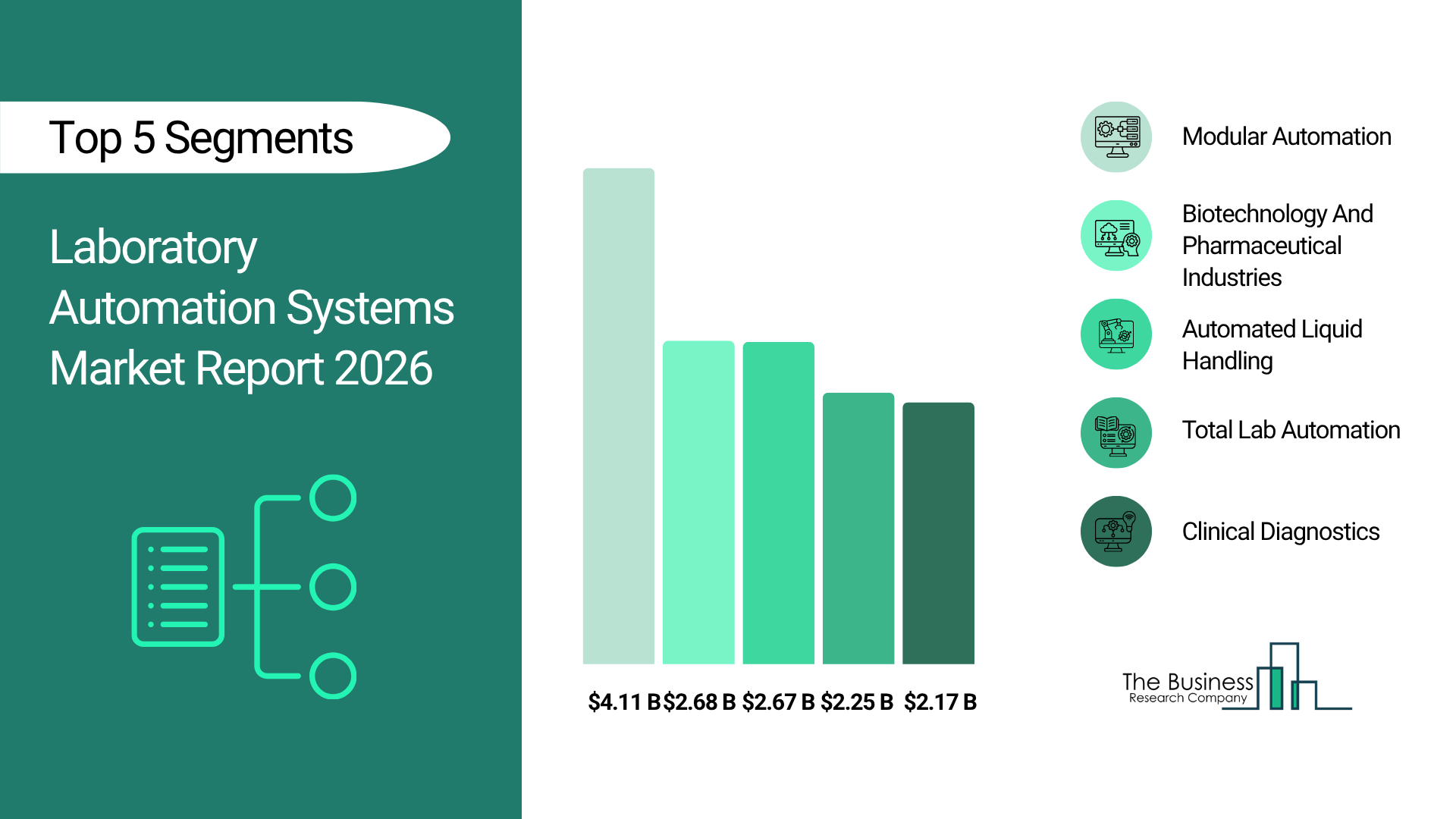
The laboratory automation systems market is segmented by type into modular automation and total lab automation. The modular automation market will be the largest segment of the laboratory automation systems market, segmented by type, accounting for 63% or $5 billion of the total in 2030. The modular automation market will be supported by its flexibility in integrating with existing laboratory workflows, growing demand for cost-effective and scalable automation solutions, increasing adoption across pharmaceutical and biotechnology industries for high-throughput screening, rising need for workflow customization and incremental automation, expanding applications in clinical diagnostics and research laboratories, and continuous technological advancements enhancing system efficiency and interoperability.
The laboratory automation systems market is segmented by equipment and software into automated liquid handling, microplate readers, standalone robots, automated storage, and retrieval. The automated liquid handling market will be the largest segment of the laboratory automation systems market, segmented by equipment and software, accounting for 42% or $3 billion of the total in 2030. The automated liquid handling market will be supported by its critical role in enhancing laboratory efficiency and accuracy, increasing demand for high-throughput screening in drug discovery and clinical diagnostics, rising adoption of robotics and digital lab solutions, growing investments in pharmaceutical and biotechnology research, expanding need for error reduction and reproducibility in experiments, and continuous advancements in precision liquid handling technologies.
The laboratory automation systems market is segmented by application into drug discovery, clinical diagnostics, genomics solutions, proteomics solutions, and other applications. The clinical diagnostics market will be the largest segment of the laboratory automation systems market, segmented by application, accounting for 33% or $3 billion of the total in 2030. The clinical diagnostics market will be supported by the increasing demand for high-throughput testing, rising prevalence of chronic and infectious diseases, growing adoption of automated laboratory solutions, expanding healthcare infrastructure globally, increasing focus on accuracy and turnaround time, and continuous advancements in diagnostic technologies.
The laboratory automation systems market is segmented by end user into biotechnology and pharmaceutical industries, research institutes, hospitals and private labs, and academic institutes. The biotechnology and pharmaceutical industries market will be the largest segment of the laboratory automation systems market, segmented by end user, accounting for 43% or $4 billion of the total in 2030. The biotechnology and pharmaceutical industries market will be supported by the increasing demand for high-throughput drug discovery, growing adoption of automated laboratory workflows, rising investments in pharmaceutical research and development, expanding biologics and personalized medicine pipelines, the need for improved accuracy and efficiency in laboratory processes, and a strong focus on reducing operational costs and turnaround time.
What Is The Expected CAGR For The Laboratory Automation Systems Market Leading Up To 2030?
The expected CAGR for the Laboratory Automation Systems market leading up to 2030 is 7%.
What Will Be The Growth Driving Factors In The Global Laboratory Automation Systems Market In The Forecast Period?
The rapid growth of the global laboratory automation systems market leading up to 2030 will be driven by the increasing demand for high-throughput and error-free laboratory operations, the integration of advanced technologies such as artificial intelligence, robotics, and analytics, growing focus on laboratory efficiency amid workforce shortages to improve scalability, and accelerate innovation across pharmaceutical, biotechnology, and clinical diagnostics ecosystems.
Rising Demand For High-Throughput And Error-Free Laboratory Operations – The increasing need for high-throughput and error-free laboratory operations is set to be a major growth driver for the laboratory automation systems market by 2030. The rising volume and complexity of testing in pharmaceuticals, biotechnology, and clinical diagnostics are accelerating the adoption of automation. Automated systems improve processing speed, enhance reproducibility, and significantly reduce human error, making them indispensable for laboratories managing large sample volumes. This is especially crucial in areas like drug discovery and diagnostics, where both speed and accuracy are critical. As laboratories strive for greater efficiency and scalability, automation is becoming a strategic priority. Consequently, the increasing need for high-throughput and error-free laboratory operations is expected to contribute approximately 2.8% annual market growth.
Integration Of Advanced Technologies – The adoption of advanced technologies will play a significant role in driving the laboratory automation systems market by 2030. The integration of artificial intelligence, robotics, and advanced analytics is transforming traditional laboratory workflows into intelligent, self-optimizing systems. These innovations enable predictive maintenance, real-time monitoring, and improved data analysis, leading to better decision-making and operational performance. AI-powered automation also minimizes downtime and supports more complex experimental processes. This technological advancement is accelerating the transition toward fully digital and connected laboratories. As a result, the adoption of advanced technologies is projected to contribute around 2.5% annual market growth.
Growing Focus On Laboratory Efficiency Amid Workforce Shortages – The increasing emphasis on laboratory efficiency in the face of workforce shortages will serve as a key growth driver for the laboratory automation systems market by 2030. Laboratories across the globe are experiencing a shortage of skilled professionals, creating a greater reliance on automation to sustain productivity. Automated systems reduce dependence on manual processes while ensuring consistent results and faster turnaround times. Moreover, automation helps laboratories manage costs and optimize resource utilization. This trend is particularly evident in clinical laboratories and healthcare settings where diagnostic demand continues to grow. Therefore, the increasing emphasis on laboratory efficiency is anticipated to support approximately 2.2% annual market growth.
Access The Detailed Laboratory Automation Systems Market Report Here
https://www.thebusinessresearchcompany.com/report/laboratory-automation-systems-global-market-report?utm_source=EINPresswire&utm_medium=Paid&utm_campaign=Apr_PR
What Are The Key Growth Opportunities In The Laboratory Automation Systems Market in 2030?
The most significant growth opportunities are anticipated in the modular automation market and the total lab automation market. Collectively, these segments are projected to contribute over $2 billion in market value by 2030, driven by increasing demand for high-throughput and error-free laboratory operations, rising adoption of automation in pharmaceutical and biotechnology research, growing need for efficient sample management and data integration, expanding investments in advanced laboratory infrastructure, and continuous technological advancements in robotics and software solutions. This surge reflects the accelerating focus on improving operational efficiency, ensuring data accuracy, and supporting large-scale research and diagnostic activities, fuelling transformative growth within the broader laboratory automation systems market.
The modular automation market is projected to grow by $1 billion, and the total lab automation market by $1 billion over the next five years from 2025 to 2030.
Learn More About The Business Research Company
The Business Research Company (www.thebusinessresearchcompany.com) is a leading market intelligence firm renowned for its expertise in company, market, and consumer research. We have published over 17,500 reports across 27 industries and 60+ geographies. Our research is powered by 1,500,000 datasets, extensive secondary research, and exclusive insights from interviews with industry leaders.
We provide continuous and custom research services, offering a range of specialized packages tailored to your needs, including Market Entry Research Package, Competitor Tracking Package, Supplier & Distributor Package and much more.
Disclaimer: Please note that the findings, conclusions and recommendations that TBRC Business Research Pvt Ltd delivers are based on information gathered in good faith from both primary and secondary sources, whose accuracy we are not always in a position to guarantee. As such TBRC Business Research Pvt Ltd can accept no liability whatever for actions taken based on any information that may subsequently prove to be incorrect. Analysis and findings included in TBRC reports and presentations are our estimates, opinions and are not intended as statements of fact or investment guidance.
Contact Us:
The Business Research Company
Americas +1 310-496-7795
Europe +44 7882 955267
Asia & Others +44 7882 955267 & +91 8897263534
Email: info@tbrc.info
Follow Us On:
LinkedIn: https://in.linkedin.com/company/the-business-research-company“
Oliver Guirdham
The Business Research Company
+44 7882 955267
info@tbrc.info
Visit us on social media:
LinkedIn
Facebook
X
Legal Disclaimer:
EIN Presswire provides this news content “as is” without warranty of any kind. We do not accept any responsibility or liability
for the accuracy, content, images, videos, licenses, completeness, legality, or reliability of the information contained in this
article. If you have any complaints or copyright issues related to this article, kindly contact the author above.

Media gallery